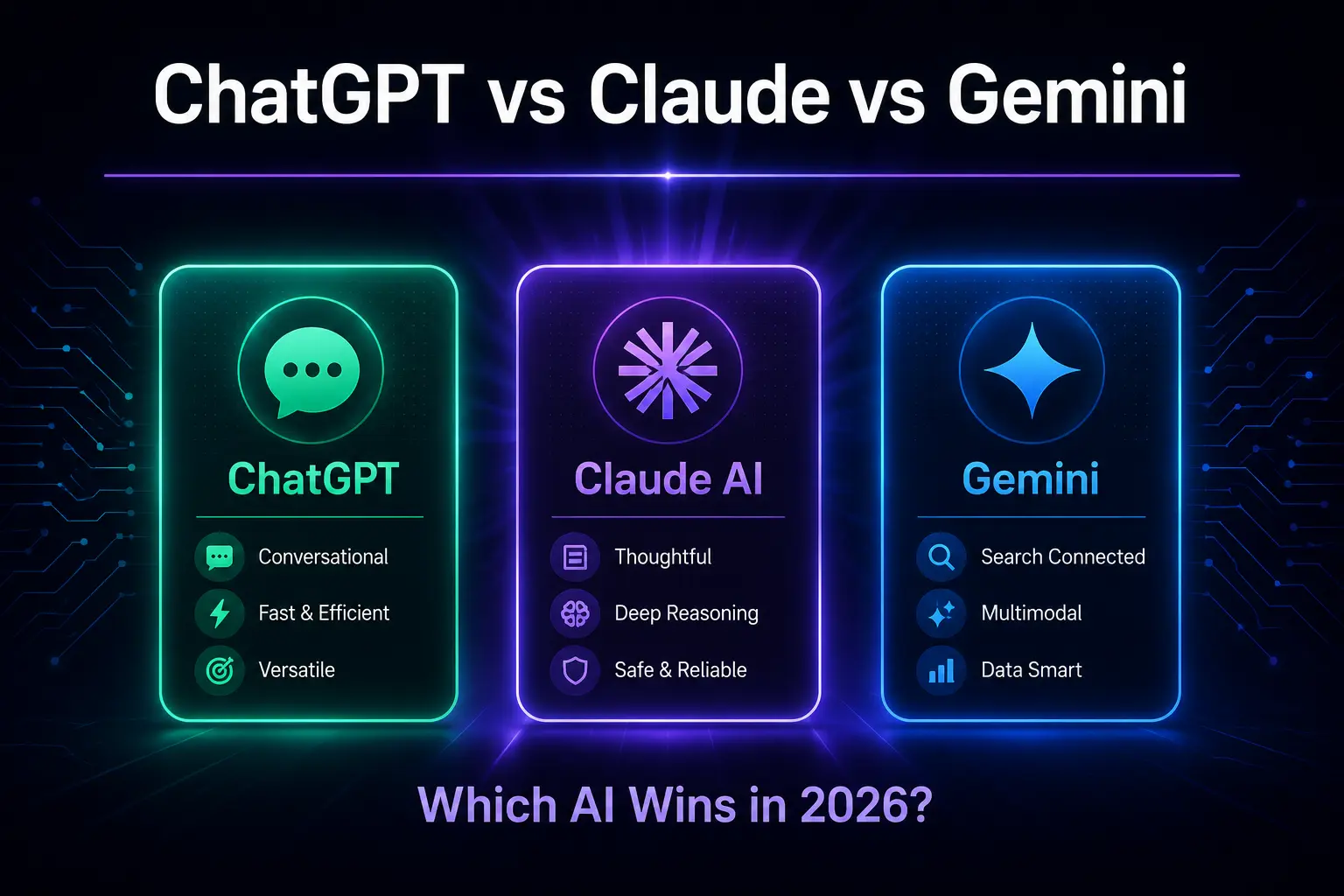
ChatGPT vs Claude AI vs Gemini: Which AI Chatbot Is Actually Best in 2026?
Let me paint a picture you’ve probably lived through.
You’re sitting at your desk trying to finish a report, write a cover letter, debug a piece of code, or just get a straight answer to a complicated question. You open an AI chatbot. It gives you something. But is it the best something? Could another chatbot have done it better, faster, or more accurately?
That question — which AI chatbot is actually best — is one of the most searched topics on the internet right now. And I’m going to answer it properly.
I’ve spent real time using all three of the dominant AI chatbots of 2026: ChatGPT (powered by OpenAI’s GPT-4o), Claude AI (from Anthropic), and Gemini (from Google DeepMind). Not casual testing. Actual day-to-day use across writing, coding, research, analysis, and creative work.
This isn’t a spec sheet comparison. I’m going to tell you what each one is actually good at, where each one falls short, and — most importantly — which one you should be using based on what you actually need it for.
Let’s get into it.
Table of Contents
Table of Contents
First, A Quick Overview: Meet the Contenders
ChatGPT — The One That Started It All
ChatGPT, developed by OpenAI, is the AI chatbot that introduced most of the world to conversational AI. Since its explosive launch in late 2022, it has evolved significantly. The current version — GPT-4o — is a multimodal model, meaning it can handle text, images, audio, and even video inputs. With over 100 million weekly active users as of 2024, it remains the most widely used AI chatbot on the planet.
ChatGPT Plus subscribers get access to advanced features including web browsing, image generation via DALL-E 3, code execution through the Advanced Data Analysis tool, and a growing library of custom GPTs — specialized chatbot configurations built for specific use cases. The free tier still offers access to GPT-4o mini, which is genuinely capable for everyday tasks.
Claude AI — The Thoughtful One
Claude is developed by Anthropic, an AI safety company founded by former OpenAI researchers, including Dario and Daniela Amodei. If ChatGPT is the fast-talking generalist, Claude is the careful, methodical expert. Claude 3.5 Sonnet — the model most users interact with — is widely regarded as one of the best AI models for reading and writing long documents, nuanced analysis, and tasks where accuracy and reasoning depth matter more than speed.
One of Claude’s most distinctive technical features is its context window: up to 200,000 tokens. That means you can paste an entire book, a massive codebase, or a full research paper into a conversation and ask Claude to work with it. No other major consumer AI chatbot comes close to this at scale.
Anthropic built Claude with an emphasis on safety and ‘Constitutional AI‘ — a training methodology designed to make the model more helpful, harmless, and honest. In practice, this means Claude tends to be more cautious than ChatGPT, more willing to acknowledge uncertainty, and less prone to confidently stating wrong information.
Gemini — Google’s Answer to Everything
Google DeepMind’s Gemini is the most recent major entrant in this race, having gone through a significant rebrand from Bard. Gemini 1.5 Pro is the flagship model, and it comes with an extraordinary 1 million token context window — the largest of any major consumer AI product. It’s deeply integrated with Google’s ecosystem, meaning it connects naturally with Gmail, Google Docs, Google Drive, YouTube, and Google Search.
For people whose work lives inside Google Workspace, Gemini offers something the others can’t: real-time access to your actual documents and emails. It also benefits from Google’s search infrastructure, giving it access to current information in a way that feels native rather than bolted on.
Side-by-Side Comparison at a Glance
Here’s how the three AI chatbots compare across key dimensions:
| Category | ChatGPT (GPT-4o) | Claude AI | Gemini 1.5 Pro |
| Developer | OpenAI | Anthropic | Google DeepMind |
| Best For | Versatility & plugins | Long documents & safety | Google Workspace & search |
| Context Window | 128K tokens | 200K tokens | 1M tokens |
| Free Tier | Yes (limited) | Yes (limited) | Yes (limited) |
| API Access | Yes | Yes | Yes |
| Image Generation | Yes (DALL-E 3) | No | Yes (Imagen) |
| Web Browsing | Yes (Plus) | Yes | Yes |
| Code Ability | Excellent | Excellent | Very Good |
| Privacy Focus | Moderate | High | Moderate |
if you’re building AI-powered websites, check out our Strapi CMS review
Round 1: Writing Quality and Tone
Writing is probably the most common use case for AI chatbots, so let’s start here.
ChatGPT
ChatGPT is a capable writer. It produces clean, readable prose, handles different tones reasonably well, and can adapt to styles from formal to conversational. The problem is that ChatGPT’s writing can feel slightly generic — it has a recognizable cadence that experienced readers start to notice. It loves lists. It over-explains. It often adds unnecessary summary paragraphs at the end of every response. For content that needs to feel genuinely human, you’ll usually need to edit ChatGPT’s output rather than use it directly.
Claude AI
Claude is, in my honest experience, the best writer of the three. The prose flows more naturally. It understands nuance better — when you ask for something thoughtful, you get something thoughtful, not a bulleted list with a header. Claude is particularly strong at long-form writing, editing existing content, matching a specific voice or style, and producing analytical writing that doesn’t read like it came from a machine. If you write professionally — blog posts, reports, essays, marketing copy — Claude should be your default.
Gemini
Gemini’s writing quality sits somewhere between the other two. It’s clean and competent, but it doesn’t have Claude’s depth or ChatGPT’s breadth of stylistic flexibility. Where Gemini shines in writing tasks is when those tasks involve summarizing information from the web or your own Google Docs — it can pull context from real sources in a way the others can’t match without plugins.
Writing Winner: Claude AI — for quality, naturalness, and long-form depth.
Round 2: Coding and Technical Tasks
For developers, the AI chatbot you use for coding could save you hours every week. This is a high-stakes category.
ChatGPT
ChatGPT’s coding capability is excellent and well-established. GPT-4o handles a wide range of languages, frameworks, and technical tasks with confidence. The Advanced Data Analysis feature lets you upload data files and run actual Python code in a sandboxed environment — a genuinely powerful feature for data work. The plugin ecosystem also includes coding-specific tools. For most developers, ChatGPT remains the go-to coding assistant.
Claude AI
Claude is an outstanding coding assistant and, for certain tasks, rivals or exceeds ChatGPT. Where Claude particularly excels is in understanding and working with large codebases. Because you can paste 200,000 tokens of code into a conversation, Claude can review an entire application, trace logic across multiple files, refactor complex systems, and explain what’s happening at a macro level. For code reviews, architecture discussions, and debugging in large projects, Claude’s context window is a decisive advantage.
Gemini
Gemini is a competent coder, and Google has invested heavily in making it strong at technical tasks. Its integration with Google Colab makes it particularly useful for data science and machine learning workflows. However, for general-purpose coding assistance, it currently sits slightly behind ChatGPT and Claude in terms of reliability and depth.
Coding Winner: Tie between ChatGPT and Claude — ChatGPT for breadth and tools; Claude for large codebase work.
Round 3: Research and Accuracy
This is where the differences between these tools matter most. An AI chatbot that confidently gives you wrong information is worse than no AI at all.
ChatGPT
ChatGPT has improved significantly in accuracy over its various iterations. With web browsing enabled, it can pull current information. However, it still has a tendency toward what the AI community calls ‘hallucinations’ — confidently stated information that is simply incorrect. For tasks requiring precise factual accuracy, you should always verify ChatGPT’s outputs, especially on specific names, dates, statistics, and citations.
Claude AI
Claude is notably more careful about uncertainty. When it doesn’t know something, it’s more likely to say so rather than fabricate an answer. This is a direct result of Anthropic’s Constitutional AI training approach. For research tasks where accuracy matters — academic work, professional analysis, fact-based writing — Claude’s tendency toward epistemic humility makes it more trustworthy than its competitors. It also handles complex reasoning tasks exceptionally well, working through multi-step problems with clear logic.
Gemini
Gemini benefits from Google’s search infrastructure, which gives it access to genuinely current information in a way that feels more native than ChatGPT’s browsing plugin. For research involving recent events, current data, or real-time information, Gemini has a structural advantage. It’s also deeply integrated with Google Scholar and academic resources, which is useful for research work.
Research Winner: Claude AI for reasoning accuracy; Gemini for real-time information access.
Round 4: Context Window and Long Document Handling
This is a technical specification that has enormous practical implications.
If you regularly work with long documents — legal contracts, research papers, entire book manuscripts, large codebases, detailed reports — the context window is probably the most important feature to consider.
ChatGPT supports 128,000 tokens in its current form, which is large by historical standards but now trails the competition. Gemini 1.5 Pro supports 1 million tokens, which is extraordinary — you could theoretically paste an entire novel or a massive codebase and ask Gemini to work with the full thing simultaneously. Claude supports 200,000 tokens, which while smaller than Gemini’s maximum, is practically sufficient for the vast majority of long-document tasks.
The practical question isn’t just how big the window is — it’s how well the model actually uses what’s in it. Research has shown that some models lose track of information from earlier in long contexts, focusing disproportionately on what was at the beginning and end. Claude has consistently performed well in tests that evaluate attention across the full context window. Gemini’s performance on very long contexts is still being validated.
Context Window Winner: Gemini (1M tokens) in raw size; Claude in practical performance across the full context.
Round 5: Multimodal Capabilities (Images, Audio, Video)
In 2026, text-only AI is table stakes. The real differentiation is in multimodal capability — the ability to work with images, audio, and other media types alongside text.
ChatGPT
ChatGPT has a significant advantage here: it integrates directly with DALL-E 3 for image generation. This means you can describe an image in a conversation and have ChatGPT generate it without switching tools. GPT-4o can also analyze images, read text in photos, describe visual content, and understand charts and diagrams. Voice mode in ChatGPT has improved dramatically, enabling natural real-time conversations with remarkably low latency.
Claude AI
Claude can analyze and understand images — you can paste a screenshot, a chart, or a photograph and ask Claude to interpret it. However, Claude does not generate images. For most professional use cases, this is not a major limitation; image understanding is more commonly needed than image generation in knowledge-work contexts. Claude also does not yet offer a voice conversation mode comparable to ChatGPT’s.
Gemini
Gemini is multimodal by design, built from the ground up to handle text, images, audio, and video. Google’s Imagen integration means Gemini can generate images, and its ability to process YouTube video content is a genuinely unique capability. For workflows that involve multimedia content — video analysis, image-heavy research, working with visual data — Gemini’s architecture gives it advantages the others don’t have.
Multimodal Winner: ChatGPT for image generation + voice; Gemini for video and multimedia breadth.
Round 6: Privacy and Data Handling
This is a dimension that doesn’t get enough attention in most AI chatbot comparisons.
Where your data goes when you type a prompt matters — especially for professional and business use. ChatGPT’s privacy settings have evolved, and OpenAI gives users options to opt out of data being used for training. However, the default settings favor data collection, and many enterprises have blocked ChatGPT precisely because of concerns about proprietary data entering OpenAI’s training pipelines.
Anthropic has built Claude with privacy as a stated priority. Claude does not use conversation data for training by default (on paid plans), and Anthropic has been relatively transparent about its data handling practices. For professionals handling sensitive information, this distinction matters.
Google’s Gemini, naturally, raises its own privacy considerations. Google’s business model is fundamentally built on data, and while Google provides Workspace-specific privacy controls, users comfortable with Google’s data practices will find Gemini’s deep ecosystem integration valuable, while privacy-conscious users may be more cautious.
Privacy Winner: Claude AI, by design and default settings.
Pricing: What Does Each AI Chatbot Cost?
All three platforms offer free tiers with meaningful capability limitations. Here’s the practical breakdown for 2026:
ChatGPT Free gives you access to GPT-4o mini with limited GPT-4o access. ChatGPT Plus at $20/month unlocks full GPT-4o access, DALL-E 3, web browsing, Advanced Data Analysis, and custom GPTs. ChatGPT Team and Enterprise tiers are available for organizations at higher price points.
Claude Free provides access to Claude 3.5 Sonnet with usage limits. Claude Pro at $20/month gives priority access, higher usage limits, and access to the latest models including Claude 3 Opus. Anthropic also offers API access and a Team plan for businesses.
Gemini Free includes access to Gemini 1.5 Flash with basic capabilities. Gemini Advanced at $19.99/month (or included in Google One AI Premium) unlocks Gemini 1.5 Pro, Google Workspace integration, and the 1 million token context window. For users already paying for Google Workspace, this pricing becomes very competitive.
At the $20/month level, all three offer strong value. The right choice depends on which platform’s strengths align with your use case — price alone shouldn’t be the deciding factor.
Which AI Chatbot Should You Actually Use?
Here’s the honest breakdown, based on real use cases:
Use ChatGPT if:
- You need an all-rounder that handles a wide variety of tasks well
- Image generation (DALL-E 3) is important to your workflow
- You rely on custom GPTs or third-party plugins
- You want the most mature, widely-supported AI ecosystem
- Voice conversation mode is a feature you’ll actually use
Use Claude AI if:
- Writing quality and naturalness are your highest priority
- You work with long documents, large codebases, or extensive research
- Accuracy and intellectual honesty matter more than speed
- You handle sensitive information and value privacy by default
- You need an AI that reasons carefully through complex problems
Use Gemini if:
- Your workflow is centered on Google Workspace (Gmail, Docs, Drive)
- You need access to the most current web information
- Working with video or multimedia content is important
- You want the largest possible context window for massive documents
- You’re already paying for Google One and want to maximize value
The Bottom Line: There Is No Single ‘Best’ AI Chatbot
I know that’s not the definitive answer you might have hoped for. But it’s the honest one.
The question of which AI chatbot is best in 2026 doesn’t have a single answer — because it depends entirely on what you’re trying to do. Each of these tools has been built with different priorities by different teams with different philosophies about what AI should be.
OpenAI built ChatGPT to be a capable, accessible generalist that works for the widest possible audience. It succeeds at that. Anthropic built Claude to be safe, careful, and deeply capable at the kinds of intellectual work that professionals and knowledge workers do every day. It succeeds at that. Google built Gemini to be the most connected AI in the world — connected to the web, to Google’s services, and to your data. It succeeds at that.
My personal recommendation: if you’re only going to use one, start with Claude for writing and analytical work. Use ChatGPT when you need its specific tool integrations or image generation. Use Gemini when you’re deep in the Google ecosystem or need real-time web data.
And honestly? Most power users in 2026 have settled on using more than one. The days of one AI chatbot ruling them all are probably behind us. The better question isn’t which is best — it’s which is best for what you’re doing right now.
Frequently Asked Questions
Is ChatGPT still the best AI chatbot in 2026?
ChatGPT remains the most widely used AI chatbot and excels at versatility, image generation, and plugin integrations. However, Claude AI has surpassed it in writing quality and long-document handling, and Gemini leads in Google ecosystem integration and context window size. ‘Best’ depends entirely on your use case.
Is Claude AI better than ChatGPT?
For writing, document analysis, reasoning accuracy, and tasks requiring careful judgment, most expert users rank Claude ahead of ChatGPT. For multimodal tasks, plugins, and general-purpose versatility, ChatGPT holds advantages. Both are excellent tools worth having access to.
Is Gemini free to use?
Yes, Google Gemini has a free tier that provides access to Gemini 1.5 Flash. Gemini Advanced, which includes Gemini 1.5 Pro and Google Workspace integration, requires a Google One AI Premium subscription at approximately $19.99/month.
Which AI chatbot is best for coding?
ChatGPT and Claude are both excellent for coding. ChatGPT offers a broader tool ecosystem including code execution. Claude’s 200K context window makes it exceptional for working with large codebases. For data science in Google Colab, Gemini has strong integration advantages.
Which AI chatbot is safest for sensitive business data?
Claude AI from Anthropic is generally considered the most privacy-conscious of the three, with data-handling defaults that favor user privacy. For enterprise deployments, all three offer organizational tiers with stronger data controls, but Claude’s default settings and Anthropic’s stated AI safety philosophy make it the preferred choice for privacy-sensitive work.